
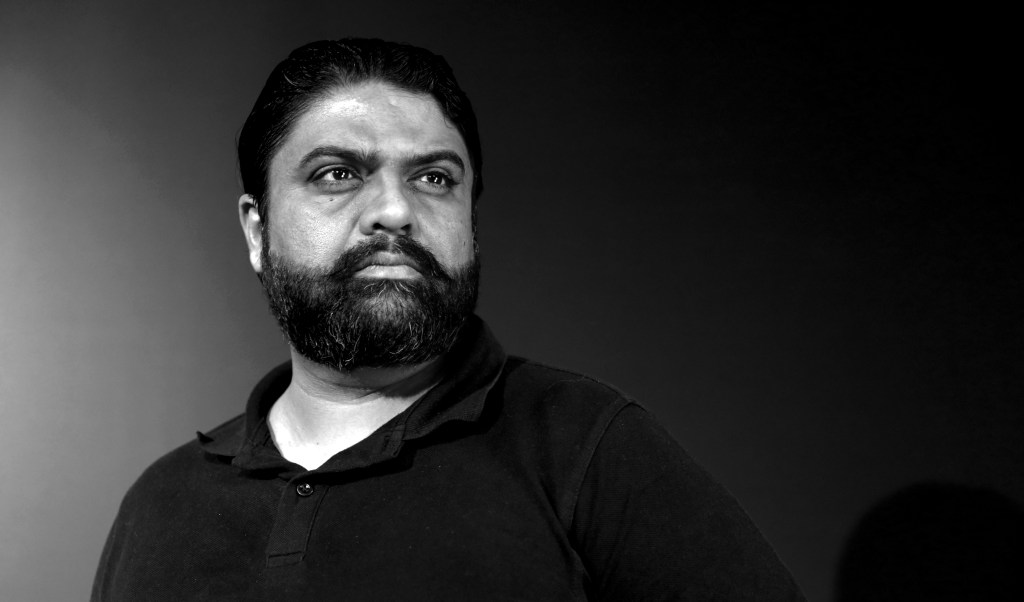
Credit: Allinson Aranha
In the heart of Dubai’s vibrant theatre community, one name resonates profoundly – Sanjeev Dixit. A multifaceted artist, Sanjeev has not only left an indelible mark on the local stage but has also ventured into uncharted territories, pushing the boundaries of traditional theatre. From his early days with ‘Theatrics’ to founding ‘Third Half Theatre,’ Sanjeev’s artistic journey is a testament to his commitment to the treading of the boards.
Reminiscing about the transformative moment that set him on his artistic journey Dixit said: “I must have been 10 or 11 perhaps when I got the opportunity to play a small part… I was the only child in a pretty serious play and got to just be a fly on the wall while discussions on intent, and theme, and “What are we trying to say?”, “How do we manage this bit?” and other heavier questions were being bandied about.”
He added: “And the camaraderie, the sense of community where everyone chipped in—we even built and painted our own theatre flats as backdrops for our set. I was absolutely smitten and have been involved with the theatre ever since.”
Since then, Sanjeev’s passion for theatre saw him navigate his way from the streets of Mumbai to the iconic venues of Dubai, transforming him into a triple threat – writer, director, and actor.
Once in Dubai, Dixit joined Theatrics in 2003, initially contributing as an actor. However, his journey took a transformative turn in 2009 during the staging of Molière’s ‘The Would Be Gentleman.’ Director K Chandrasekhar recognized Sanjeev’s unique perspective, prompting an offer for the role of Assistant Director. This marked a pivotal moment where Sanjeev shifted from the immersive world of an actor to the spatial and conceptual realm of a director, delving into the intricacies of mise-en-scène.
A vivid memory from this period involves a creative impasse during the production. Faced with the challenge of incorporating a song into a pivotal scene, Sanjeev found himself inspired to fill the void left by Molière’s unconventional text. Unable to ignore his creative instincts, he worked through the night, crafting a song that seamlessly integrated into the play. This incident not only showcased Sanjeev’s ability to adapt and innovate but also marked a significant turning point in the production, where he even ventured into choreography.
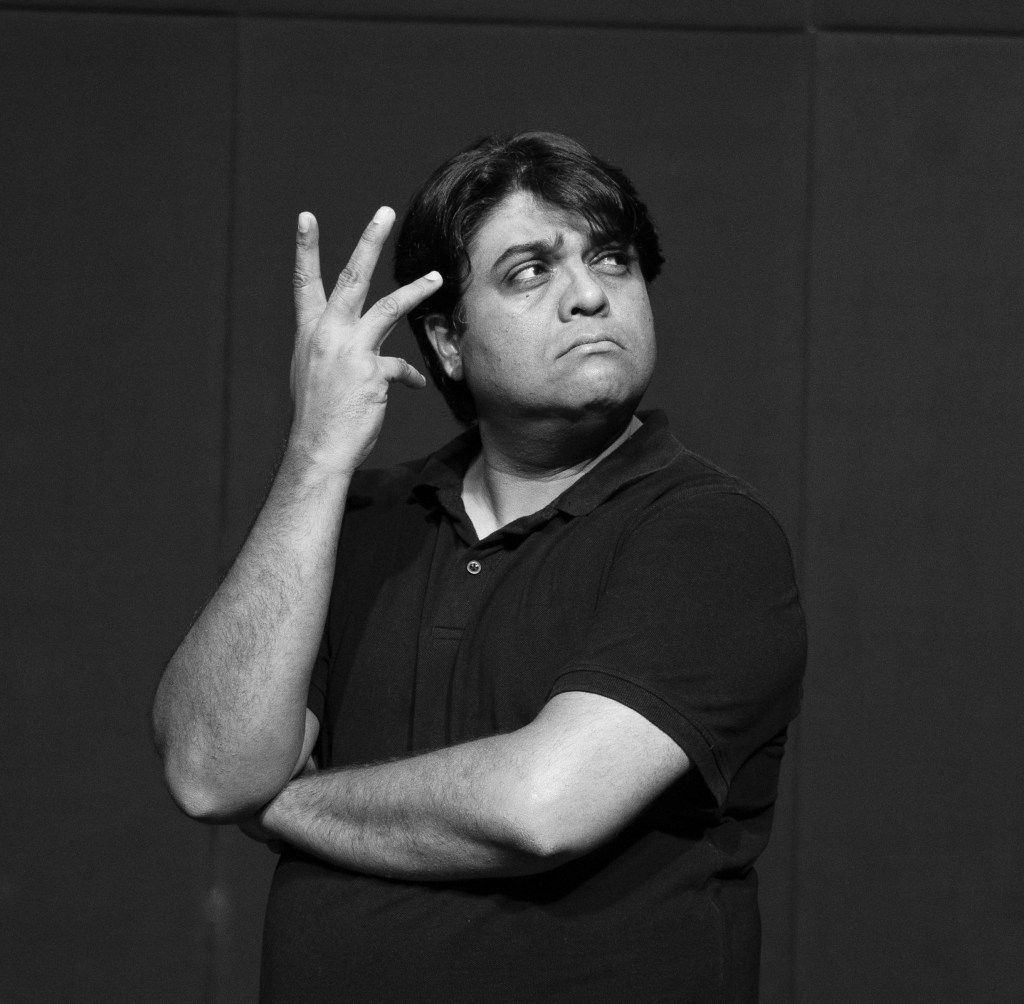
Credit: Talha Shafiq
“There was this big number in the middle of the play and Molière’s text was so irreverent—imagine, this was written in 1670—that we couldn’t use the song he had intended originally. After much back and forth, it was decided to just do away with the number. Somehow that didn’t sit right with me, and I remember being unable to sleep that night. Then, like a bolt from the blue, words started forming and I sat upright, grabbed my phone and furiously typed them out. The next day, we had a song for the big number. That was quite a turning point,” Sanjeev said.
A few years later, Sanjeev took a bold step by launching Third Half Theatre, a pioneering group committed to the theatre as an art form. The company’s second production featured a compelling evening of plays, including one by Chekhov, his stage adaptation of a classic short story, and his inaugural completely original short play, ‘Garçon.’
Since then, he has continued to make a mark in the Dubai theatre scene, having written and directed numerous short plays, full-length productions, and even Broadway-style musical extravaganzas. These have been staged at various short play festivals in Dubai, featured in The Emirates Litfest Fringe, The Sikka Art Fair, in addition to international performances in India and the USA. Sanjeev is also associated with Malhaar, Dubai’s only classical Indian choir, and has staged grand Hindustani classical musicals with them.
His creative journey took another turn when he wrote and directed Dubai’s first English musical ‘Amazing Dubai’ in 2017, a brainchild of social entrepreneur Brian Wilkie, which ran two shows daily for six months at The Madinat Theatre.


Clockwise from top: Thirty Days in September, Haaye Akhtari, Jeffery Bernard is Unwell, and Still Dancing
Credit: Third Half Theatre
Over time, this had led to Dixit increasingly focusing on women’s issues-based material, noting that his plays often tend to have a female lead and when that isn’t the case, they have strong female representation.
In 2019, Sanjeev also tackled the sensitive issue of Parkinson’s disease with ‘Still Dancing,’ a play that aimed to raise awareness. It was staged by Third Half Theatre in association with Social Enterprise Movement Mantra, and received heartening responses, connecting with Parkinson’s heroes, caregivers, and audiences, bringing attention to the pressing issue.
“Dr. Vonita Singh, the founder of Movement Mantra uses Kathak and other movement modalities as therapy for people with Parkinson’s. She always wanted to do a play on her experiences. As it happened Shereen Saif, who at the time was working with me on my play ‘Sutradhar’, introduced us and the play was premiered at The Junction in April 2019. It was recently revived in May 2023, and we are now gearing up for our first Indian premiere [in] April 2024,” he said, smiling.
Most recently, Dixit staged ‘Thirty Days in September’ by celebrated Indian playwright Mahesh Dattani, which explores childhood trauma, showcasing theatre’s power to delve into poignant narratives.
“I directed the play and acted in it, which is a unique challenge. It’s an incredibly well researched script that doesn’t pull any punches, and the audience responses to it were exceptional. It’s a topic very rarely discussed, and the play encourages victims to reach out, be heard, and find a path forward,” Sanjeev said.
When asked whether there’s a particular work in his impressive body of work that held particular significance for him, Dixit immediately recalled his short play ‘Tréteau’, which utilised a minimalist approach to theatre inspired by travelling French troupes who would perform from the back of a carriage.
“Almost nobody understands it, but it is still universally appreciated by those who have seen it. It confounds even its actors. I don’t know why, though. To me it seems quite obvious…I chose to throw all my favourite stage influences into the piece in a bit of theatrical mayhem. It is a precisely scripted piece, which is why when theatre aficionados assume it has been workshopped makes the writing of it all the more satisfying,” he explained, adding that it also taught him to trust his creative instincts.
That’s something that has been honed over decades as an expatriate artist, reflecting the dichotomy of belonging to two homes and infusing Sanjeev’s works with themes of transience and identity.
“The idea of acknowledging that home is home, that you can go there whenever you want to, but also realising, while you’re in Dubai, “Wait a minute, this is home!” Also, Dubai is a real melting pot of cultures and nationalities. Its approach of tolerance and bonhomie between cultures is a beacon in an increasingly polarized world view,” he mused.
This is reflected in seemingly disparate works, such as the inaugural Bayut Your Home Your Choice Awards at the Dubai Opera, a Crayons event for Bayut in 2021, and ‘The Emerald House,’ an interactive, immersive theatre experience that Sanjeev wrote and directed in 2022.
“Every play is a challenge, and each one requires a fresh approach… I think working in different genres, and across cultures, has given me a sense of adventure as also a sort of cross-sectional awareness that enriches my work both while I am immersed in it and when it finally finds expression on stage in front of an audience,” he said.

Credit: Talha Shafiq
Building on that sense of transience, Dixit emphasized the need for adaptability and constantly pushing personal and creative boundaries, whether through collaborations or exploring diverse topics through artistic expression.
“I have had several exemplary collaborations over the years [including with young actors and collaborators]…the key is to challenge your boundaries, firstly. And once you do, the next thing is to keep the doors open. I have learnt so much from collaborating with amazing artists who have taught me so much and have left an indelible impression on my work…I’ve also had the pleasure of working with a team that truly understands where I’m coming from and helps me realise it effectively,” Sanjeev stressed.
Another thing that he acknowledged artists of all styles and backgrounds have had to grapple with is the influence of digital technology, especially smartphones, and how they pose challenges for storytelling. Sanjeev, however, sees it as an opportunity to explore innovative ways of engaging the audience: “In a world obsessed with soulless brevity… theatre is the only salvation.”
At the same time, though, he observed that digital tools can’t be ignored – just make sure that you don’t get sucked into a ‘rabbit hole’: “As with any tool, it depends how you utilise them, of course, but online forms for auditions, tabulated data, mailing lists, even AI are incredibly helpful. Social Media is [also] critical [for] outreach…[but] to be effective, you need to dedicate time, and the more time you give, the more it sucks you in. And then the other work that requires focus suffers.”
Another piece of advice Sanjeev shared, rings especially true for those starting out on their artistic path: “The idea is to be aware of what’s happening, research and educate oneself on what has happened, as also why it may have happened in the first place. Approaching everything with an objective of learning, of exploring, and then creating is how I like to look at things.”
Discipline, trust, staying genuine, and having a sense of adventure are also important: “Often deliberating on any particular idea, or thought, or script just makes it chaotic. Sometimes you have to go and do something else, and let your subconscious mind figure it out for you. It’s a cheat code, really.”
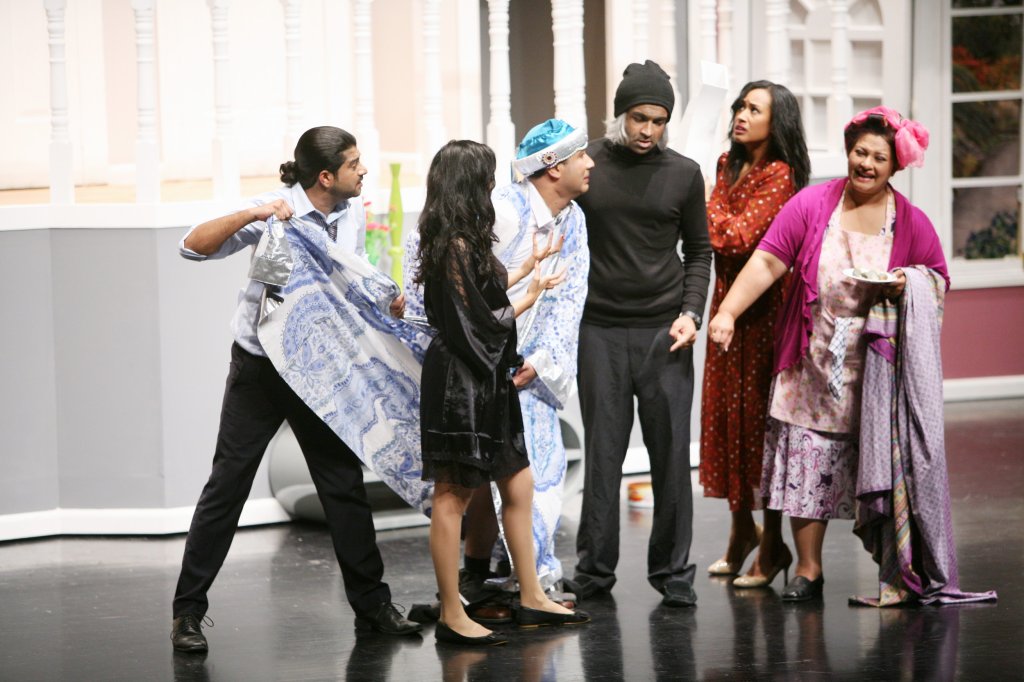


Clockwise from top: Noises Off, Amazing Dubai, The Tragic Queen, and Sutradhar
Credit: Third Half Theatre
It’s also imperative to have a strong support structure, whether it’s an understanding spouse or family, friends who are encouraging, or from others within the artistic community who can provide motivation.
As he looks ahead, Sanjeev’s artistic journey continues, an ever-evolving narrative of passion, exploration, and a commitment to the transformative power of theatre. “I regard the theatre as the greatest of all art forms,” quotes Oscar Wilde, encapsulating his enduring love for the stage.
Among his current projects are a Mumbai performance of ‘Still Dancing’ as well as multiple Third Half Theatre productions, including two musicals and a farce play.
Dixit also remains firmly committed to nurturing the theatre culture in Dubai. He aspires to see a day when serious practitioners can make a career out of theatre in the city. Balancing personal and professional goals, he envisions continued writing, exploring new genres, and possibly venturing into screenwriting and stand-up comedy.
“I’ve been a part of the Dubai theatre community for nigh on 20 years now. It has always been, I feel, a bit of a niche pursuit overall for most folk in the community… in five years if the theatre culture in Dubai allows for serious practitioners to actually make a career out of it, I would consider it a milestone,” Sanjeev said.
He continued: “In the future, who knows what dreams may come…I am drawn to challenges, and keep trying to push myself out of my comfort zone. Screenwriting and maybe even stand up comedy might be on the cards. It is a question of having the time too. 2024 is shaping up to be a busy year already, but I intend to find the time to work on my pet projects nevertheless.”
One thing’s certain though – in a world often obsessed with brevity, Sanjeev’s theatre stands as a sanctuary, a place where genuine human connections are forged and lasting moments are created.
 CREATIVITY UNDEFINED